Why it exists
Make temperature, humidity, and soil-moisture conditions visible remotely and at the device.
2023 / Project case study
Connected Crop Monitoring
An ESP32 agriculture-monitoring system that reads temperature, humidity, and soil moisture, sends telemetry to Blynk, and drives local status indicators.
Make temperature, humidity, and soil-moisture conditions visible remotely and at the device.
Connected ESP32 sensing, Blynk telemetry, and local threshold indicators in one monitoring workflow.
ESP32 sensing · Blynk telemetry
Explore the implementationI built Smart Agri as a connected sensing prototype around an ESP32, DHT11 climate sensor, analog soil-moisture probe, Wi-Fi, and Blynk. The firmware publishes field readings to remote widgets and drives local LED indicators for temperature, humidity, and moisture conditions, creating a compact device-to-cloud monitoring loop.
Connected agriculture projectThe DHT11 feeds temperature readings into the connected monitoring loop.
Air humidity is sampled alongside temperature for a more useful crop-environment view.
An analog probe adds soil-condition information to the same device workflow.
Three environmental signals are published over Wi-Fi to remote Blynk widgets.
Dedicated LEDs translate sensor thresholds into immediate device-side feedback.
Environmental inputs are sampled at the edge, published remotely, and translated into immediate local feedback.
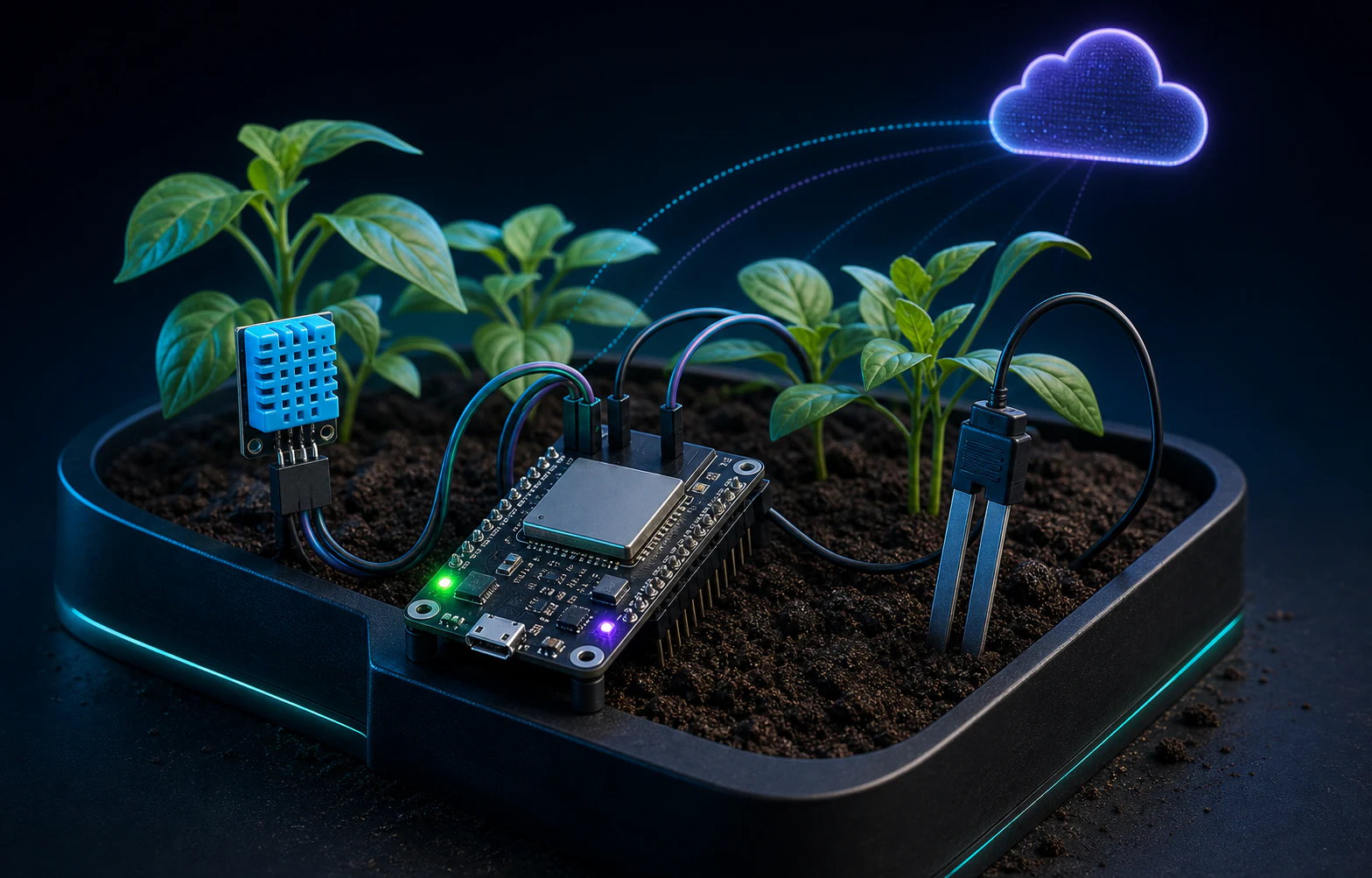
The ESP32 samples climate and soil inputs, publishes the readings to Blynk, and evaluates thresholds for local LED feedback.
Actual project screens and documented visuals. Open any image for the full view.
Analog moisture readings and environmental thresholds need calibration against the actual soil, enclosure, and crop conditions.
Remote telemetry and on-device indicators must describe the same condition without conflicting states.
A production revision should externalize network and provider credentials, rotate device tokens, and validate failed-sensor behavior.
Open a technology to see its role in this project.
Sensor sampling, thresholds, and local indicators
Connected controller and Wi-Fi runtime
Temperature and humidity sensing
Analog soil-condition input
Remote temperature, humidity, and moisture telemetry
Device-to-cloud connectivity
Structured sensor channels for the mobile dashboard
Local threshold feedback for field conditions
Temperature, humidity, and soil moisture share one monitoring workflow.
The ESP32 publishes readings over Wi-Fi for remote observation.
Threshold indicators keep essential status visible at the device.
Explore the available resources or talk with me about the design and engineering behind this project.