Why it exists
Give producers a reliable record of their farms and day-to-day work, while making selected origin information usable by a wider traceability platform.
2026 / Project case study
Farm Operations within an Olive-Oil Traceability Platform
My Producer/Farm module in a five-person traceability project: ownership-protected farm management, private maps, activity journals, and AI action plans that producers review before use.
Give producers a reliable record of their farms and day-to-day work, while making selected origin information usable by a wider traceability platform.
Owned the ProducerProfile/Farm domain in a five-person team: data relationships, ownership checks, private maps and uploads, farm journals, public-origin rules, and producer-reviewed AI plans. The other supply-chain modules and shared platform are team work.
Integrated local application · Producer/Farm domain
Explore the implementationOliveTrace follows Tunisian olive oil from producer to consumer. I owned the ProducerProfile and Farm domain: Eloquent relationships, validated CRUD, access policies, private uploads and maps, opt-in public origin cards, activity journals, and saved AI advice. Stable farm references connect my module to the team’s harvest, certification, distribution, and consumer modules. Authentication, roles, layouts, and infrastructure are shared platform work. The documented delivery includes automated checks and a local Docker deployment; no hosted deployment is claimed.
Academic team project · Five contributorsProducers manage their own profiles and farms. Ownership policies, service checks, validation, and restricted foreign keys protect domain relationships.
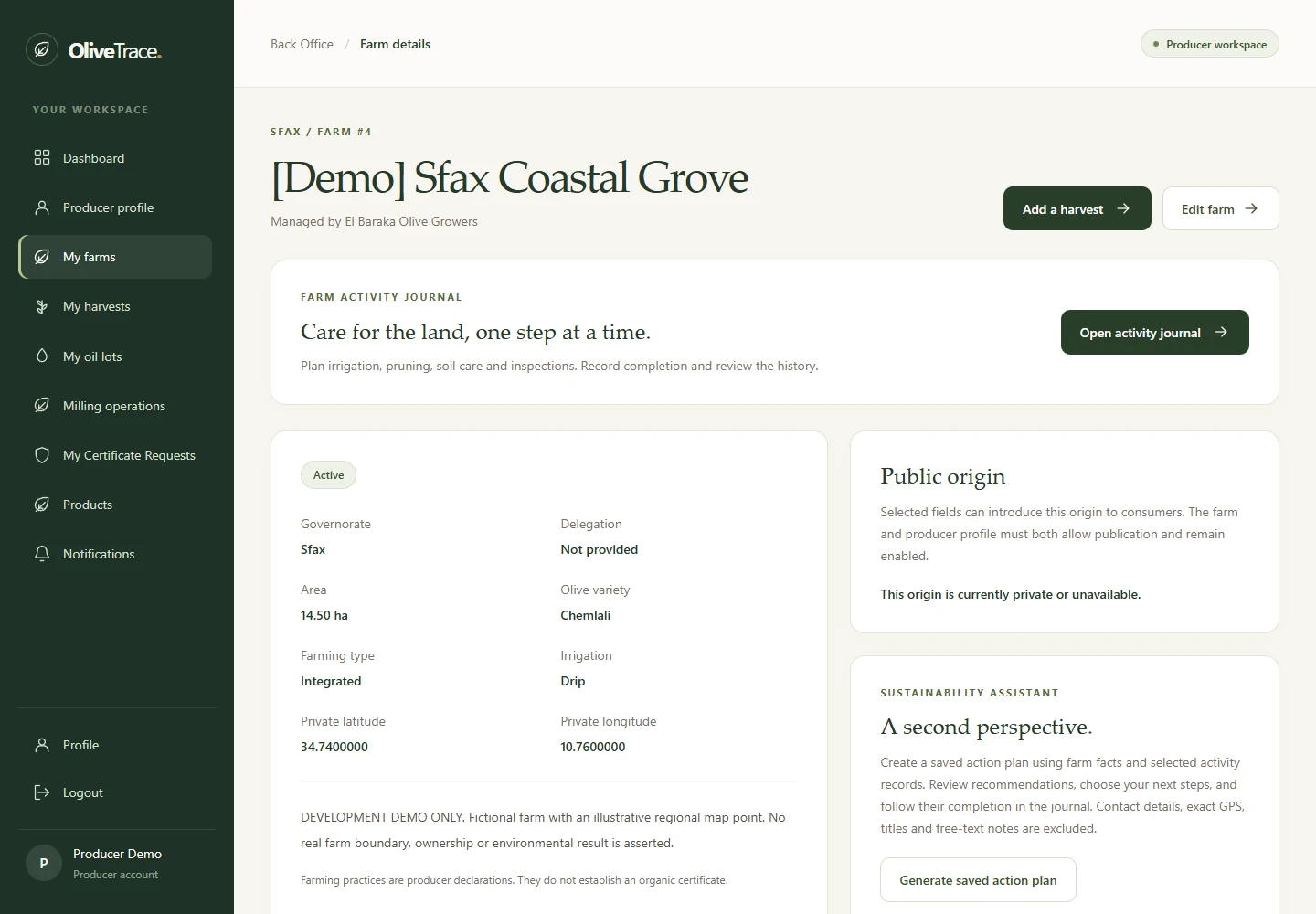
Owners and admins can inspect exact farm locations. Public origin cards require both profile and farm opt-in, and omit contact details and precise coordinates.
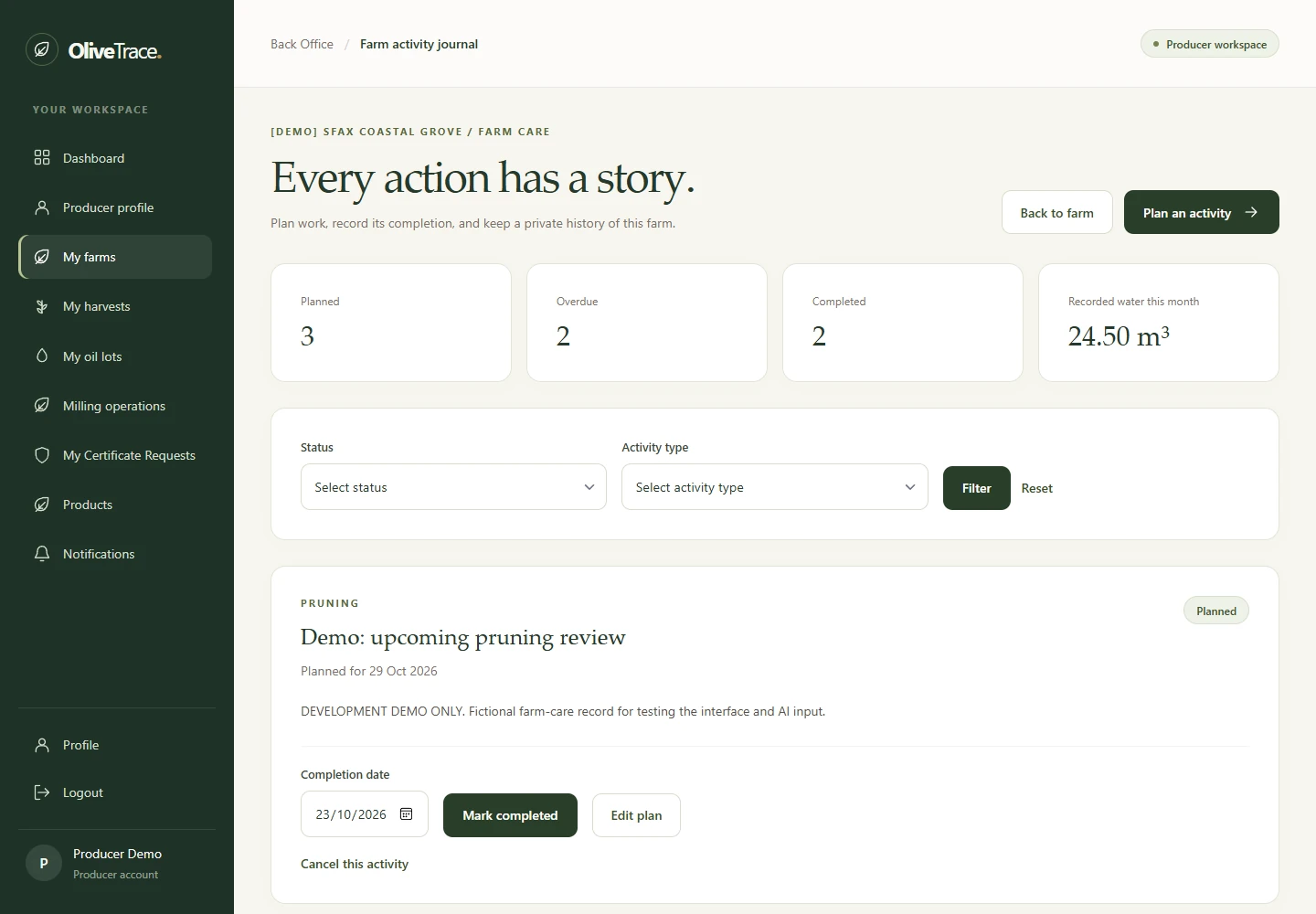
Plan, edit, complete, or cancel farm work with date and water-use validation, overdue indicators, and retained history.
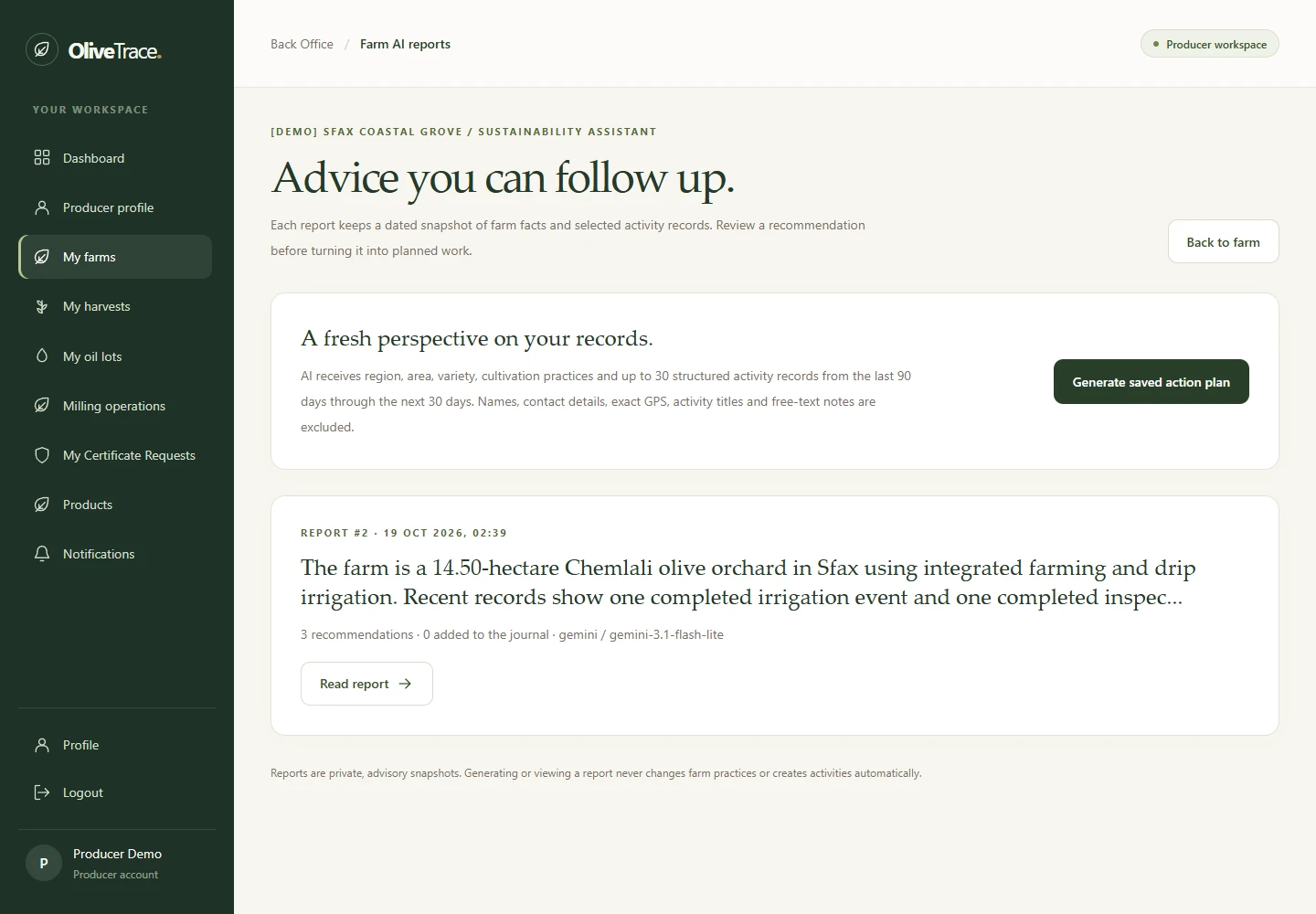
Save a snapshot of relevant farm facts and validated AI recommendations. Producers explicitly choose which suggestions become journal activities.
Shared farm IDs and selectable-farm rules connect to the harvest module. A public-origin service provides selected provenance data to the consumer module.
The Producer/Farm domain owns farm operations and reviewed advice. Stable references connect it to the shared traceability platform.
My implementation centers on ProducerProfile, Farm, activity records, and advice reports. The wider application combines five student modules; authentication, common user management, layouts, and infrastructure are shared work.
A report stores its input snapshot and validated recommendations. Contact information, precise GPS, activity titles, and free-text notes are excluded from provider inputs. Advice never changes farm records automatically; adoption is an explicit producer action.
Actual project screens and documented visuals. Open any image for the full view.
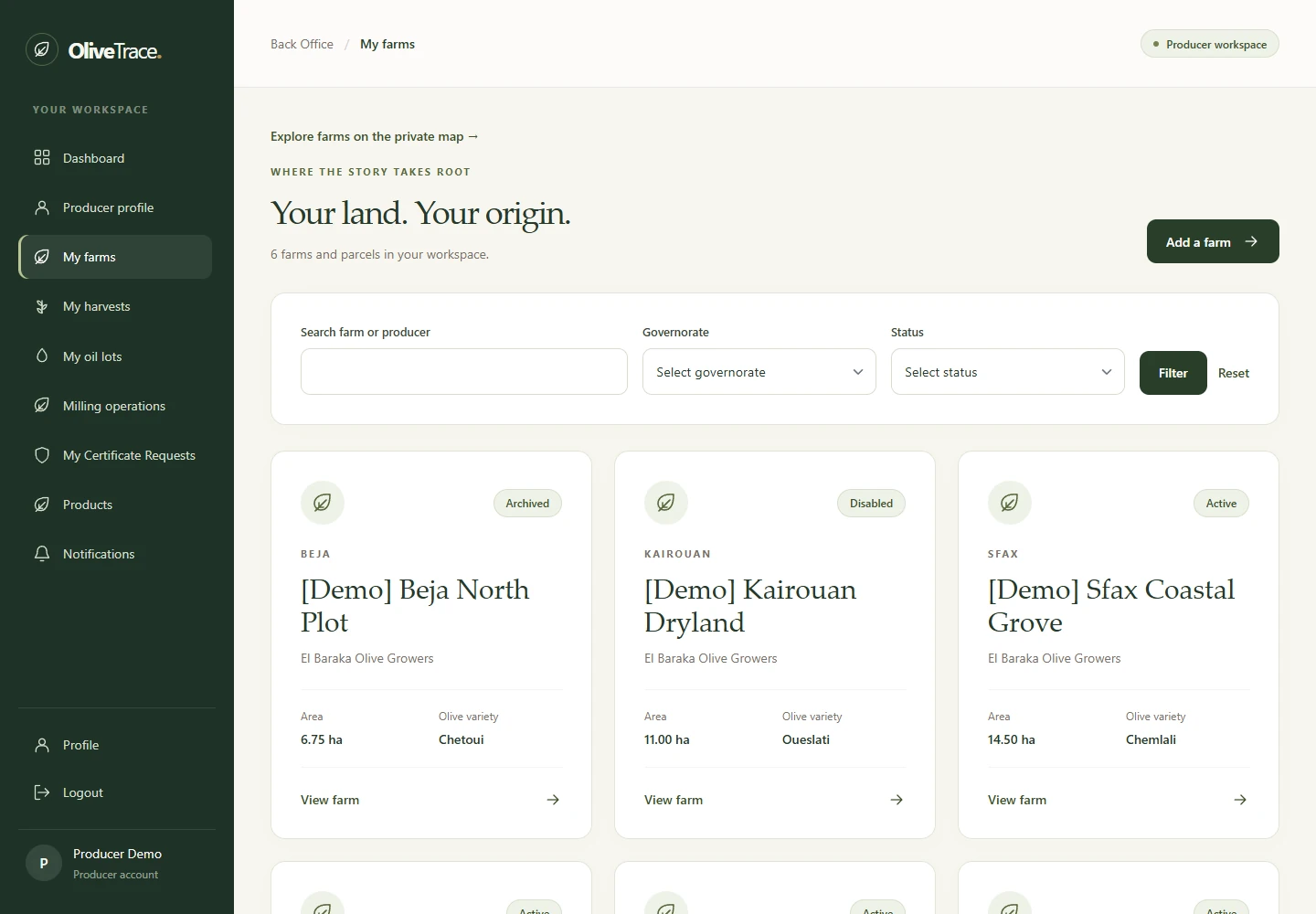
Archive farms that have linked history instead of deleting their provenance. Foreign-key restrictions and service rules keep downstream references intact.
Public origin is a deliberately limited view, with explicit publication rules. Private logos, contacts, notes, and exact coordinates stay outside that contract.
Documented farm selectors and origin contracts let other modules integrate without duplicating producer data or bypassing ownership and status checks.
Open a technology to see its role in this project.
Controllers, Form Requests, ownership policies, services, and automated checks.
Server-rendered workspaces and reusable forms within shared Front/Back Office layouts.
ProducerProfile/Farm relationships, foreign keys, retained history, and integration references.
Private location picker and farm overview, with explicit map loading.
Configurable providers for saved advice; normal farm operations work without AI.
Documented local application and MySQL deployment with persistent storage.
Team pipeline with formatting, SQLite/MySQL tests, coverage reports, and a quality gate.
Producer/Farm features operate inside the team application with real MySQL relationships and shared authorization infrastructure.
The 22 October handover documents the automated pipeline and verified local Docker setup. Public hosting is not confirmed in that handover.
Saved snapshots, validated outputs, and explicit producer adoption connect advice to follow-up work without autonomous changes.
Explore the available resources or talk with me about the design and engineering behind this project.